
Distance learning
in numbers.
How many really study at a distance, how many work alongside it, what it costs and how much time it eats up. FernStudent gathers the data on distance learning and makes it visible: sourced, independent and without advertising.
The big FernStudent survey
What is distance learning really like, from the inside? Help build the first independent dataset on distance-learning students. Fully anonymous, about 3 minutes.
Distance learning at a glance
Four numbers that shape distance learning. Each leads to its own report with the details, the sources and the date.
In short: In Germany around 250,000 people are enrolled in distance learning, 8.6% of all students. The number has almost quadrupled since 2006, carried above all by private distance universities.
Distance learning in data
Seven data reports, each on its own page. Sourced numbers, clearly visualised, no marketing.
Distance learning in numbers
How many people study at a distance in Germany, which subjects lead and how fast the market grows. The core numbers at a glance.
Read moreStudy and work
How many distance students work alongside their studies, how they finance them and how old they are on average. Their reality in data.
Read moreTime commitment
How many hours a week a distance degree realistically takes, how it spreads across exam phases and where most people struggle.
Read moreCosts and funding
What a distance degree really costs over its full duration, how prices spread and how many use funding.
Read moreDistance universities in numbers
Who the big providers are, how fast the market grows and how distance students are distributed. The ranking in official numbers.
Read moreWho studies at a distance?
Share of women, average age, employment and subjects: the demographics of distance students in official numbers.
Read moreDropout in numbers
The DZHW dropout rates for bachelor and master, the most common reasons and what of it is actually documented for distance learning.
Read moreThe largest subject groups
Business and law provide by far the most distance study programmes, followed by society and social affairs as well as engineering. This is how the programmes are distributed across the subject groups.
In short: Well over one in three distance study programmes (38%) is a business or law subject. Together, the five largest subject groups cover more than 90% of all distance study programmes.
Distance study programmes by subject group
Share of all distance study programmes, HRK subject classification.
Data as a table
| Subject group | Share |
|---|---|
| Economics, Law | 38.3% |
| Social and behavioural sciences | 17.7% |
| Engineering | 15.4% |
| Mathematics, Natural sciences | 13.6% |
| Medicine, Health sciences | 9.6% |
| Other subject groups | 5.4% |
Distance learning in Germany, Austria and Switzerland
The market is of different sizes across the DACH region and is counted differently. The order of magnitude by country, honestly defined.
Germany
largest market
FernUni Hagen is the largest state university in the country, joined by larger private distance universities such as the IU. Together this makes up by far the largest group of distance learners in the DACH region. Counting is done via the official higher education statistics.
Austria
smaller, growing
Many Austrians study at German distance universities, which the national statistics alone do not capture. The formats alongside work are growing, the data situation is more scattered than in Germany.
Switzerland
its own system
Switzerland counts much of it via higher vocational education and training and the continuing education formats CAS, DAS and MAS. Pure distance study programmes are rarer, but the offering alongside work is dense. A direct comparison of numbers with Germany therefore falls short.
Your distance learning knowledge, lesson by lesson
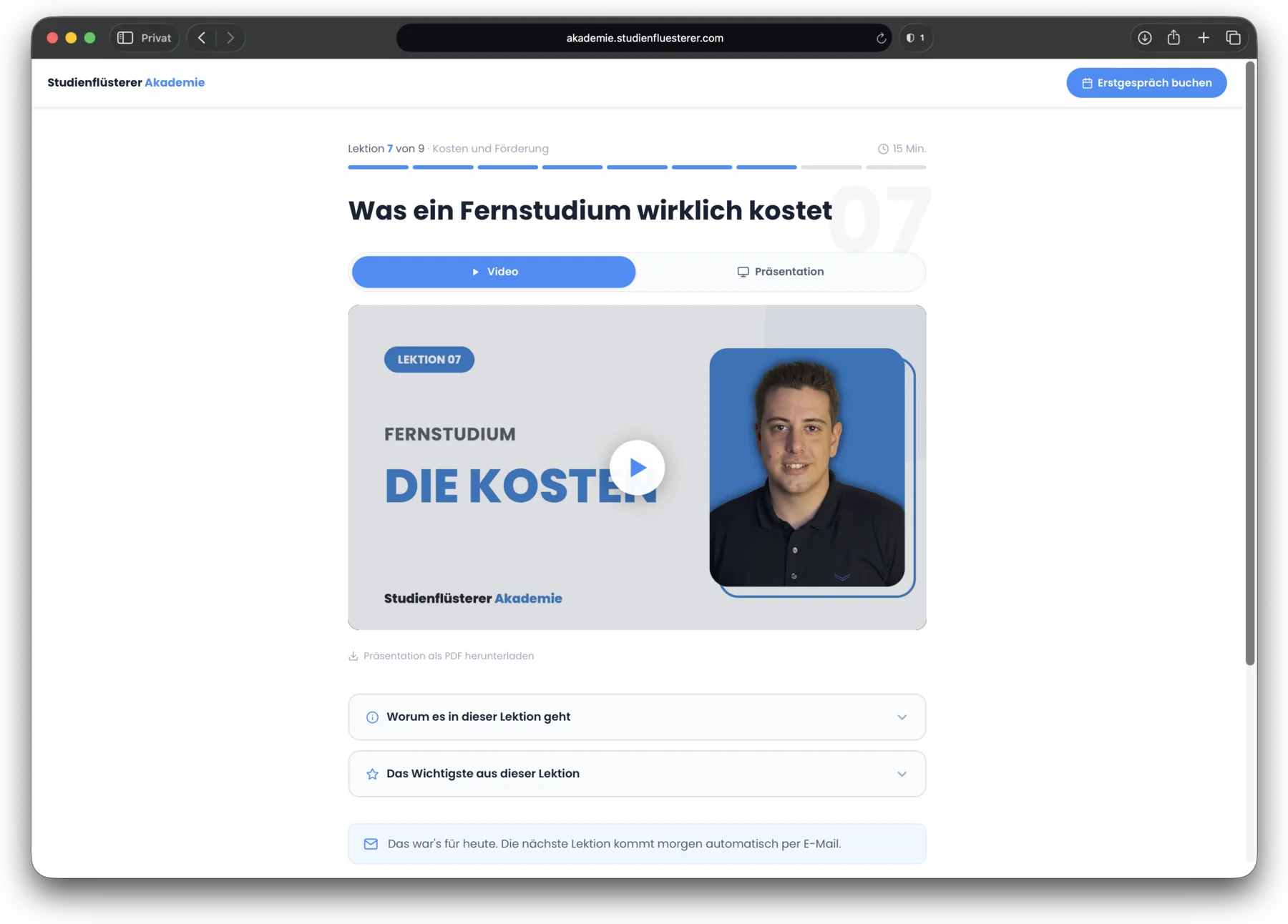
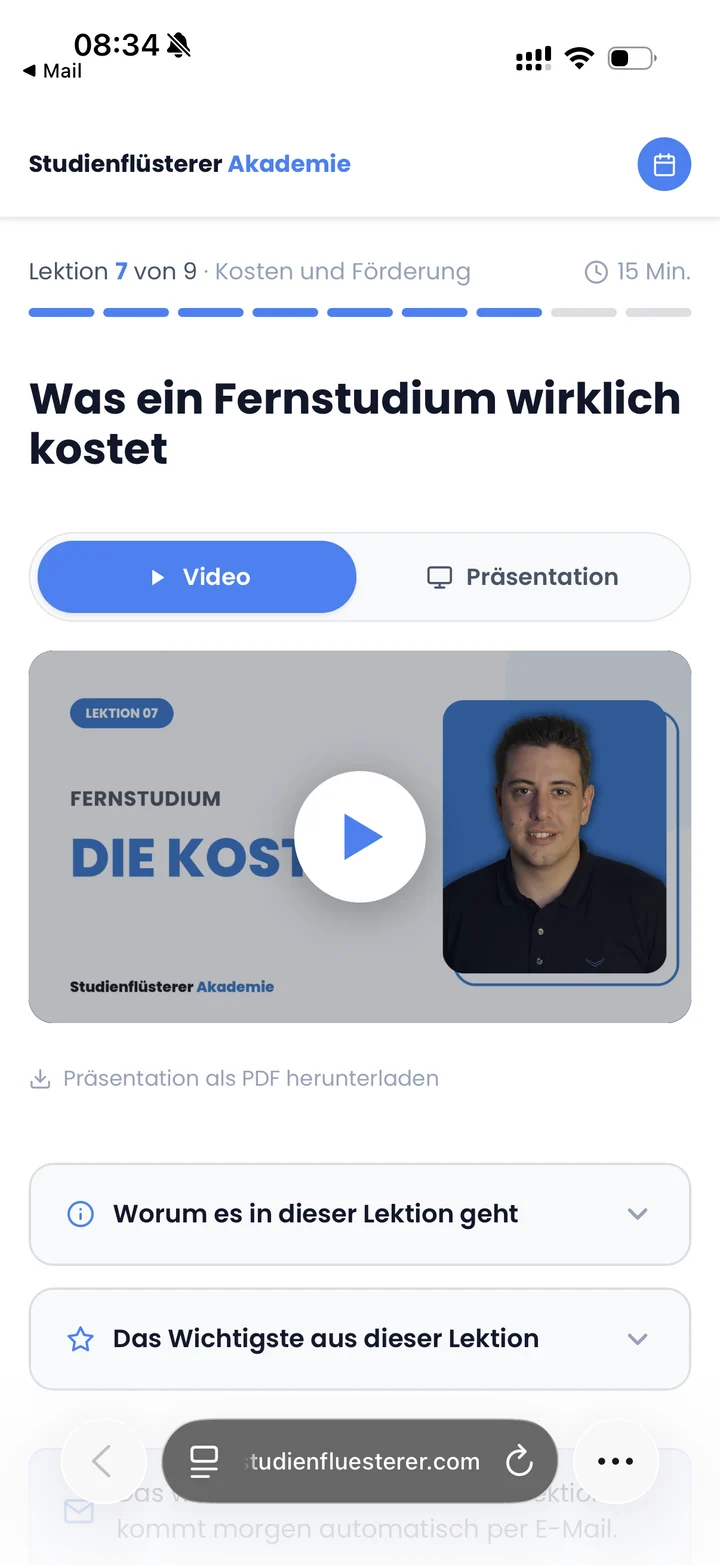
In the Studienflüsterer Academy you get the most important basics on distance learning, costs, funding and credit transfer as a compact video course. A new lesson every day, free and at your own pace.
- Short video lessons with a presentation to take away
- A new lesson in your inbox automatically every day
- On laptop and phone, learn whenever and wherever it suits you
Where the numbers come from
So you can trust the data, we disclose how it comes about. Five steps, from source to chart.
Review primary sources
We start with the reliable bodies: the Federal Statistical Office (Destatis), the reports of FernUni Hagen and other official statistics. No second-hand number without tracing it back to the original source.
Bring together and put in context
The values come from different surveys with different definitions. We bring them to a common denominator and state what was counted in each case, so the numbers stay comparable.
State source and date
Below every chart are the source and the date. Where a number fluctuates, we show a range instead of a false value. This keeps it traceable where each figure comes from.
Add our own survey
Where public data stops, we ask ourselves. A survey among distance learners provides values that no official statistic collects, for example on motivation, reasons for dropping out and everyday life. The results appear as a separate report.
Keep it current
As soon as a source publishes new numbers, we bring the report up to date and update the date. Data that becomes outdated is replaced, not left standing.
In short: sourced numbers with a source, honest ranges instead of false precision and a visible date. This is how scattered statistics should become a reliable picture.
Frequently asked questions about the data
The most important questions on the origin, timeliness and use of the numbers on FernStudent.
Where do the numbers on FernStudent come from?
From public, reliable primary sources such as the Federal Statistical Office (Destatis), the reports of FernUni Hagen and other official statistics. We bring these sources together, put them in context and give the source and the date for every number.
How up to date is the data?
Every chart carries a date and the source. We update the reports as soon as a source publishes new numbers. Where values change continuously, we give ranges instead of a single number that quickly becomes outdated.
Does FernStudent also collect its own data?
At present FernStudent prepares public statistics, for example from the Federal Statistical Office (Destatis), the HRK university compass and FernUni Hagen, every number with source and date. In addition, an own survey of distance learners is planned, whose results will appear as a separate report as soon as enough answers are in.
Is FernStudent independent?
Yes. There are no paid placements and no advertising banners. FernStudent is the data part of a project by Ritter Bildungs- und Digitalberatung, which also runs Studienflüsterer and the free academy. This proximity is disclosed, the analysis stays neutral.
May I cite the numbers?
Yes, gladly with a source reference. Every report contains a ready-made citation note. For numbers that come from an official statistic, please additionally name the original source given there, which we indicate in each case.
Why are there sometimes ranges instead of exact numbers?
Because costs, duration or funding amounts vary strongly depending on provider, country and year. A range reflects reality more honestly than a single number that is only correct for a special case. Where a source provides an exact value, we show it with its date.
How many people study at a distance in Germany?
The number depends on the definition, because some statistics count pure distance universities and others count all formats alongside work. FernStudent brings together the figures of the Federal Statistical Office (Destatis) and FernUni Hagen and states the definition transparently.
What distinguishes FernStudent from comparison portals?
Comparison portals rate individual providers. FernStudent looks at the big picture: how many study at a distance, how they live, what it costs. It is about the data situation on distance learning as a whole, not about a ranking of individual universities.
Background to the numbers
Short, independent articles that put individual numbers from the reports in context.
FernUni Hagen in numbers
Why a single university shapes the picture of distance learning.
Read the articleThe largest distance universities
Who, alongside FernUni Hagen, carries the market, and how to measure size honestly.
Read the articleHow old are distance learners?
Why distance learning is the study of the employed.
Read the articleDropout rate in distance learning
Why there is no simple number and what decides success.
Read the articleAufstiegs-BAföG: what it funds
When the funding really applies, and when it does not.
Read the articleBeyond the numbers
The data gives you the lay of the land. For the next step, there are three ways to go deeper.
Studienflüsterer
Personal guidance on your own situation. The Studienflüsterer looks at your case in a free initial consultation.
Free initial consultationFernstudium Klartext
Behind the numbers sits the context: honest, ad-free orientation on recognition, costs and how to spot reputable providers.
To Fernstudium KlartextThe academy
The most important basics as a free video course. A new lesson every day, at your own pace.
To the academySeen the numbers, still have questions?
The data shows the big picture. Your specific case, with your prior achievements and your goal, is best clarified in a personal conversation. At Studienflüsterer the initial consultation is free and without obligation.